

- Conference Proceedings
- Submit
The Conference Proceedings will be published with an ISSN Number. To ensure the quality and validity of the proceedings, all full papers submitted for conference proceedings will undergo a double-blind review process. Upon acceptance, these papers will be published electronically in the proceedings with a unique DOI number. This ensures that each paper is assigned a persistent identifier that can be used for citation and tracking purposes.
ISSN 3030-1726 (Online)
To submit your paper for proceedings publication, prepare your paper according to the provided template. This will ensure that your submission adheres to the necessary formatting and style requirements, and is ready for the review process.
https://www.dpublication.com/conference-proceedings/index.php/LGBTCONF
Following the submission of your manuscript, you may direct any inquiries through your panel under the ‘Pre-Review Discussions’ section, and they will be addressed at the earliest convenience.
- • Gender & Society (GAS)
- • Journal of Advanced Research in Women’s Studies (JARWS)
- • The Indian Journal of Gender Studies (IJGS)
- • Sexuality and Gender Studies Journal (SGSJ)
- • Journal of Language and Sexuality (JLS)
- • Journal of Advanced Research in Social Sciences (JARSS)
- • Masculinities and Social Change
- • Violence and Gender
- • Gender, Technology and Development
- • Journal of Gender Studies

- Short Description
- Instructions for Authors
- Submission
Gender & Society, the official journal of Sociologists for Women in Society, is a top-ranked journal in sociology and women’s studies and publishes less than 10% of all papers submitted to it. Articles analyze gender and gendered processes in interactions, organizations, societies, and global and transnational spaces.
- Deadline: 28 August 2025
- ISSN: 0891-2432
- Online ISSN: 1552-3977
- Journal Link: https://journals.sagepub.com/home/gas
- Abstracting/ Indexing: Scopus, Sexual Diversity Studies (formerly Gay & Lesbian Abstracts), Social SciSearch, Social Science Source, Social Sciences Citation Index (Web of Science) and many other databases.
- Scopus index link: https://www.scopus.com/sourceid/14925
- Publication Fee: No APC
Papers should be approximately 9,000 words, including an abstract (150-200 words), notes, and references. All tables, figures, and appendices must be submitted separately from the paper, and should be submitted together in one supplemental file. Authors should consult the Chicago Manual of Style, Style B, for citations and references, or refer to the Gender & Society style manual, available below. Authors should not number the pages; the online system will number the pages.
Manuscripts should be submitted electronically to http://mc.manuscriptcentral.com/gendsoc. Submitting authors are required to set up an online account on the SageTrack system powered by ScholarOne. Manuscripts that are accepted for review will be sent out anonymously for editorial evaluation.

- Short Description
- Instructions for Authors
- Submission
Journal of Advanced Research in Women’s Studies is a global forum for interdisciplinary research contributions in the area of feminism and women’s studies. JARWS welcomes submission of high-quality articles in all areas of women, culture and society, women and health, feminist methodologies, gender and public policy, transnational feminisms, women and migration, women’s leadership and social change, race and women.
- Deadline: 28 August 2025
- ISSN: 2783-7122 (Electronic Version)
- Journal Link: https://diamondopen.com/journals/index.php/jarws
- Publication fee: No APC
- Abstracting/ Indexing: Index Copernicus, DRJI, ResearchBib, Scientific Indexing Services, Scientific Indexing Services, Scilit, CiteFactor, WCOSJ, and Google Scholar. JARWS has linked its papers to references by DOIs assigned by Crossref.
Manuscripts should be organized as follows:
- Title page: List title, authors, and affiliations as first page of manuscript
- Abstract: an abstract should summarize the key points of the manuscript in 150 to 250 words. An abstract is a short summary of a larger work for the purpose of condensing the argument, conclusions, and/or results into a paragraph. After the abstract, please supply up to five keywords or brief phrases.
Manuscript should follow the style detailed in the APA publication manual.
- Introduction
- Materials and Methods
- Results
- Discussion
- Conclusions (optional)
- Acknowledgments (if applicable)
- References: This journal uses the “APA” Reference style. Each listed reference should be cited in the text, and each text citation should be listed in the references section.
- Supporting information captions (if applicable)
Figure captions are inserted immediately after the first paragraph in which the figure is cited.
Tables are inserted immediately after the first paragraph in which they are cited.
Register in the following link and submit your paper on the Journal online Submission platform:
https://diamondopen.com/journals/index.php/jarws/user/register
- Short Description
- Instructions for Authors
- Submission
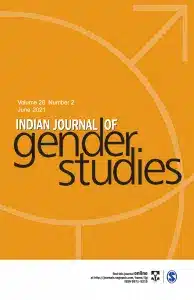
The Indian Journal of Gender Studies is a peer-reviewed journal. It aims at providing a holistic understanding of society. Its objective is to encourage and publish research, analysis and informed discussion on issues relating to gender. Often, contributions challenge existing social attitudes and academic biases that obstruct a holistic understanding of the role of the family, particularly of its women members, community and a wider polity. In recent years, the journal has focused on women in politics, violence as a phenomenon, disability, the social organization of the family, women’s livelihood matters, institutional, legal and policy questions, and motherhood and child care.
- Deadline: 28 August 2025
- eISSN: 0973-0672
- Journal Link: https://journals.sagepub.com/home/ijg
- Abstracting and Indexing: SCOPUS, Australian Business Deans Council (ABDC), Bibliography of Asian Studies (BAS), CABELLS Journalytics, CCC, Clarivate Analytics: Social Science Citation Index (SSCI), DeepDyve, Dutch-KB, EBSCO, EBSCO: EconLit, Indian Citation Index (ICI), J-Gate, OCLC, Ohio, Portico, Pro-Quest-RSP, ProQuest-Illustrata, ProQuest: International Bibliography of the Social Sciences (IBSS), Research Papers in Economics (RePEc), Social Services Abstracts – ProQuest, Sociological Abstracts – ProQuest, Studies on Women and Gender Abstracts, UGC-CARE (GROUP II).
- Scopus index link: https://www.scopus.com/sourceid/23701
- Publication Fee: No APC
- The word limit is 8000 including references, abstract, titles, endnotes, tables, name/s of author/s and designation/s.
- The Journal accepts original work followed by qualitative methodology and does not acknowledge papers with quantitative methodology
- The editors will decide the weather topic will be interesting for our readership or not
- Each and every paper has to go through rigorous peer review process.
Authors could send the papers to the following email address and note that they are participants of the Gender studies Conference.

- Short Description
- Instructions for Authors
- Submission
SGSJ welcomes research articles in the area of Sexuality and Gender Studies from the following subject areas but not limited to: gender and popular culture, gender and children’s literature, gender and technology, gender and violence, sexuality studies, transgender studies, sexual violence, and gender inequality approach.
- Deadline: 28 August 2025
- ISSN: 2783-7130
- Journal Link: https://diamondopen.com/journals/index.php/sgsj
- Abstracting/ Indexing: Index Copernicus, DRJI, ResearchBib, Scientific Indexing Services, Scientific Indexing Services, Scilit, CiteFactor, WCOSJ, and Google Scholar. SGSJ has linked its papers to references by DOIs assigned by Crossref.
- Publication Fee: No APC
Manuscripts should be organized as follows:
- Title page: List title, authors, and affiliations as first page of manuscript
- Abstract: an abstract should summarize the key points of the manuscript in 150 to 250 words. An abstract is a short summary of a larger work for the purpose of condensing the argument, conclusions, and/or results into a paragraph. After the abstract, please supply up to five keywords or brief phrases.
Manuscript should follow the style detailed in the APA publication manual.
- Introduction
- Materials and Methods
- Results
- Discussion
- Conclusions (optional)
- Acknowledgments (if applicable)
- References: This journal uses the “APA” Reference style. Each listed reference should be cited in the text, and each text citation should be listed in the references section.
- Supporting information captions (if applicable)
Figure captions are inserted immediately after the first paragraph in which the figure is cited.
Tables are inserted immediately after the first paragraph in which they are cited.
Register in the following link and submit your paper on the Journal online Submission platform:
https://diamondopen.com/journals/index.php/sgsj/user/register
- Short Description
- Instructions for Authors
- Submission
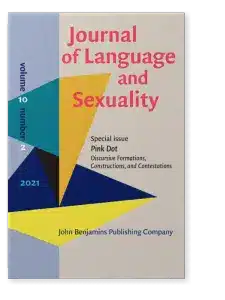
The Journal of Language and Sexuality aims to present research on the discursive formations of sexuality, including sexual desire, sexual identities, sexual politics and sexuality in diaspora. Of interest is linguistic work in the widest possible sense, including work in sociolinguistics, anthropological linguistics, pragmatics, semantics, discourse analysis, applied linguistics, and other modes of language-centered inquiry that will contribute to the investigation of discourses of sexuality and their linguistic and social consequences. On a theoretical level, the journal is indebted to Queer Linguistics as its major influence.
- Deadline: 28 August 2025
- ISSN: 2211-3770
- E-ISSN: 2211-3789
- Journal Link: https://www.benjamins.com/catalog/jls
- Abstracting/ Indexing: CNKI Scholar ; Dimensions ; Glottolog ; IBR/IBZ ; Linguistics Abstracts Online ; Linguistics and Language Behavior Abstracts (LLBA) ; MLA International Bibliography ; Scopus
- Scopus index link: https://www.scopus.com/sourceid/21100939605
- Publication Fee: No APC
*All papers MUST be withing major focus of the journal which is on language in relation to gender and sexuality. *
- All articles published in JLS are peer reviewed. For initial submission, authors should deliver their MANUSCRIPT in electronic form (MS Word, accompanied by an identical PDF file), double spaced with 3 cm/1 inch margins, with font Times New Roman, 12 pt, throughout. Do not use headers. The first page should contain the title of the article, an abstract (100–150 words), and a list of five to eight keywords (do not capitalise keywords and separate them by commas). Preferred article length is 8,000 to 9,000 words. Please use the JLS manuscript guidelines below already for the FIRST VERSION of your submission. For any formal aspects that are not treated in these guidelines, please consult recent issues of JLS as a point of reference.
- Contributions must be in ENGLISH. If not written by a native speaker, it is advisable to have the paper proofread by a native speaker before handing it in. Spelling should be American English or British English, and consistent throughout the paper.
- Authors are kindly asked to use NON-DISCRIMINATORY LANGUAGE in their articles. More specifically, they should make an effort to use gender-fair, non-heteronormative and non-stigmatising wording wherever possible. For example, avoid the term homosexualwhen referring to people and nominal uses of sexual descriptive adjectives (a bisexual, gays etc). Trans-identified individuals should be referred to with the pronouns that they prefer.
- Authors are responsible for observing COPYRIGHT laws when quoting or reproducing material. The copyright of articles published in JLS is held by the publisher. Permission for the author to use the article elsewhere will be granted by the publisher provided full acknowledgement is given to the source.
- Papers should be reasonably divided into SECTIONS and, if appropriate, subsections. Paragraphs are marked by indenting the first line. Only the first paragraph after each heading stays unindented. The headings of sections should be numbered in Arabic numerals (1.; 1.1; 1.1.1). First-level headings are in bold, third-level headings in italics. Only the first word and potentially occurring proper names are capitalised in headings:
- Forms that are analysed or discussed in the text need to be italicized (e.g. the word gay; the phrase that’s so gay). Do not use quotation marks for this purpose. Non-English language material must be accompanied by an English translation in quotation marks (e.g. schwul“gay”). LINGUISTIC DATA EXCERPTS need to be consecutively numbered, noted in italics and accompanied by an English translation (where necessary).
Passages that are left out in data excerpts should be marked as […].
- Short QUOTATIONS in the main text must be written in quotation marks. Quotations that are longer than three lines should be indented and set off from the main text (without quotation marks). Passages that are left out in quotations should be marked as […]. For all quotations, the source must be specified, including page numbers.
- FIGURES should be submitted as reproducible originals, numbered consecutively, and provided with appropriate captions. All figures must be referred to in the main text and their envisaged place should be indicated in the manuscript.
- TABLES should be numbered consecutively and must be referred to in the main text.
- Notes should appear as FOOTNOTES (not endnotes). They should be concise, kept to a minimum, and numbered consecutively throughout the paper. Authors who make excessive use of footnotes will be asked to drastically reduce their number. In the main text, footnote numbers are placed after the punctuation mark in a sentence.
- REFERENCES IN THE TEXT should look as follows:
Single author: Paradis (2004) notes … , Paradis (2004: 112) notes …
Two authors: Baugh and Cable (1999) note …
Three or more authors: Hay, Wright and Bent (2005: 112) note…
Works that have been written or edited by more than three authors should first be quoted by listing all authors’ names. For all additional quotations of these works, an abbreviated form should be used: Campbell-Kibler et al. (2002) note…
References in brackets should have the following form (the order of names is determined alphabetically, not chronologically):
(Paradis 2004, Smith & Timm 2001, Turner, Warner & Young 1997)
With page numbers: (Paradis 2004: 105–110; Smith & Timm 2001: 49; Turner, Warner & Young 1997: 111f.)
Note that for a range of continuous pages or years a long dash (–) needs to be used between figures (e.g. 105–110; 1999–2003). This is relevant both for in-text references and the references section.
- ACKNOWLEDGEMENTS and TRANSCRIPTION CONVENTIONS (if needed) should be placed before the references section.
- REFERENCES SECTION: All publications mentioned in the main text must be included in the references section and vice versa. References are listed in alphabetical order. In general, titles of books and journals are capitalised, while titles of articles are not. At least one of the authors’ and editors’ forenames must be given in full (except for scholars that invariably use initials in their publications).
Manuscripts should be submitted electronically to https://www.editorialmanager.com/jols/

- Short Description
- Instructions for Authors
- Submission
The Journal welcomes contributions that promote the exchange of ideas and rational discourse between practicing educators and social sciences researchers all over the world. A broad outline of the journal’s scope includes peer-reviewed original research articles, case, and technical reports, reviews and analyses papers, short communications and notes to the editor, in interdisciplinary information on the practice and status of research in social sciences. Thus high-quality research papers or reviews dealing with any aspect of social sciences are welcome. Papers may be theoretical, interpretative or experimental.
-
- Deadline: 28 August 2025
- Journal Link: Journal of Advanced Research in Social Sciences
- ISSN: 2538-919X (Electronic Version)
- Publication fee: €100 (Upon acceptance)
- Indexing/Abstracting: Google Scholar , OpenAlex , Crossref , Scilit
Manuscripts should be organized as follows:
- Title page: List title, authors, and affiliations as first page of manuscript
- Abstract: an abstract should summarize the key points of the manuscript in 150 to 250 words. An abstract is a short summary of a larger work for the purpose of condensing the argument, conclusions, and/or results into a paragraph. After the abstract, please supply up to five keywords or brief phrases.
Manuscript should follow the style detailed in the APA publication manual.
- Introduction
- Materials and Methods
- Results
- Discussion
- Conclusions (optional)
- Acknowledgments (if applicable)
- References: This journal uses the “APA” Reference style. Each listed reference should be cited in the text, and each text citation should be listed in the references section.
- Supporting information captions (if applicable)
Figure captions are inserted immediately after the first paragraph in which the figure is cited.
Tables are inserted immediately after the first paragraph in which they are cited.
Login Or Register in the following link and submit your paper on the Journal online Submission platform:

- Short Description
- Instructions for Authors
- Submission
The Journal on Masculinities and Social Change (known by its Spanish acronym MCS) is an Open Acces four-monthly journal that aims to publish research outcomes with significant contributions to masculinities and their influence on social transformations. MCS does not only collect research outcomes from different disciplines and methodological approaches, but also research carried out by interdisciplinary research teams. In this line, disciplinary and interdisciplinary works related to masculinities studies are welcomed.This scientific Journal emerges from the lack of journals about masculinities in Spain and Latin America which are indexed in international Social Sciences databases such as the Social Science Citation Index and SCOPUS. MCS wants to be a complete and reliable source of information on research and theoretical contributions to the field of masculinities.
ISSN: 2014-3605
Journal Link: https://hipatiapress.com/hpjournals/index.php/mcs/
Indexing/abstracting: Web of Science: Emerging Sources Citation Index, SCOPUS, Psicodoc
Scopus index link: https://www.scopus.com/sourceid/21100444326
Publication fee- https://hipatiapress.com/hpjournals/index.php/mcs/about/submissions
Author Guidelines: https://hipatiapress.com/hpjournals/index.php/mcs/about/submissions

- Short Description
- Instructions for Authors
- Submission
Violence and Gender is the only peer-reviewed journal focusing on the role of gender in the understanding, prediction, and prevention of acts of violence. The Journal is the international forum for the critical examination of biological, genetic, behavioral, psychological, racial, ethnic, and cultural factors as they relate to the gender of perpetrators of violence. Through peer-reviewed research, roundtable discussions, case studies, and other original content, Violence and Gender explores the difficult issues that are vital to threat assessment and prevention of the epidemic of violence.
ISSN: 2326-7836
Journal Link: https://home.liebertpub.com/publications/violence-and-gender/620/overview
Indexing/abstracting: BenchSci, EBSCO, Global Health, ProQuest databases, PsycINFO, PubMed Central, SafetyLit, Scopus, Web of Science: Emerging Sources Citation Index™ (ESCI)
Scopus index link: https://www.scopus.com/sourceid/21100801744
Publication fee- https://home.liebertpub.com/publications/violence-and-gender/620/for-authors#costs

- Short Description
- Instructions for Authors
- Submission
An international, refereed journal, Gender, Technology and Development serves as a forum for exploring the linkages between gender relations, development and/or technological change. The objective of the journal is to provide a platform for original research and theorizing on the shifting meanings of gender, as it relates to advances in science and technologies and/or to social, political, economic, and cultural change. In particular, the journal is interested in addressing these in the context of transnational phenomena and engaging in dialogues that cut across geographical boundaries.
ISSN: 0971-8524
Journal Link: https://www.tandfonline.com/journals/rgtd20
Indexing/abstracting: Emerging Sources Citation Index (ESCI), Scopus, DeepDyve, OCLC, J-Gate, Portico, T&F's Studies on Women and Gender Abstracts
Scopus index link: https://www.scopus.com/sourceid/23641
Publication fee- https://www.tandfonline.com/action/authorSubmission?show=instructions&journalCode=rgtd20

- Short Description
- Instructions for Authors
- Submission
The Journal of Gender Studies is a global peer-reviewed journal that showcases original research on gender for an interdisciplinary readership. JGS publishes critical, innovative and high-quality scholarly work in gender studies that engages with the wide-ranging thinkers and movements that constitute feminist, queer and transgender theory. Dedicated to the development of original work investigating the intersections of gender with other relevant categories such as sexuality, race, class, ability, age, culture, politics, religion and location, JGS promotes an international dialogue, seeks affinities with social justice struggles, and engages with contemporary debates and developments in the theorising and lived experience of people of all genders.
ISSN: 0958-9236
Indexing/abstracting: British Humanities Index, Feminist Periodicals;PsycINFO; Scopus
Scopus index link: https://www.scopus.com/sourceid/23704
Publication fee- https://www.tandfonline.com/action/authorSubmission?show=instructions&journalCode=cjgs20